• Captains ChairBlog


    Ahoy Mateys!

    This week we have another guest sitting in the Captain’s Chair! I’d like you all to welcome Stephen Kozeniewski. WELCOME HIM!

    Don’t know Stephen? LEARN!

    Kozeniewski photo

    Stephen Kozeniewski lives with his wife and two cats in Pennsylvania, the birthplace of the modern zombie. He was born to the soothing strains of “Boogie With Stu” even though The Who are far superior to Zep, for reasons that he doesn’t even really want to get into right now.

    During his time as a Field Artillery officer, he served for three years in Oklahoma and one in Iraq, where due to what he assumes was a clerical error, he was awarded the Bronze Star. The depiction of addiction in his fiction is strongly informed by the three years he spent working at a substance abuse clinic, an experience which also ensures that he employs strict moderation when enjoying the occasional highball of Old Crow.

    He is also a classically trained linguist, which sounds much more impressive than saying his bachelor’s degree is in German.

    HE HAS A DEGREE IN GERMAN! WHY AM I YELLING SO MUCH IN THIS POST?

    How about we just move along. Enjoy!

    ***

    Before I ever met or exchanged two words with Jake Bible he became one of the most important people in my professional life. Jake was (actually still is) one of my “Also Boughts.” If this is an odd term for you, don’t panic: it just means that you’re not a) going crazy or b) an author.

    This is an easier concept to explain visually than with words, so let me just show you this graphic:
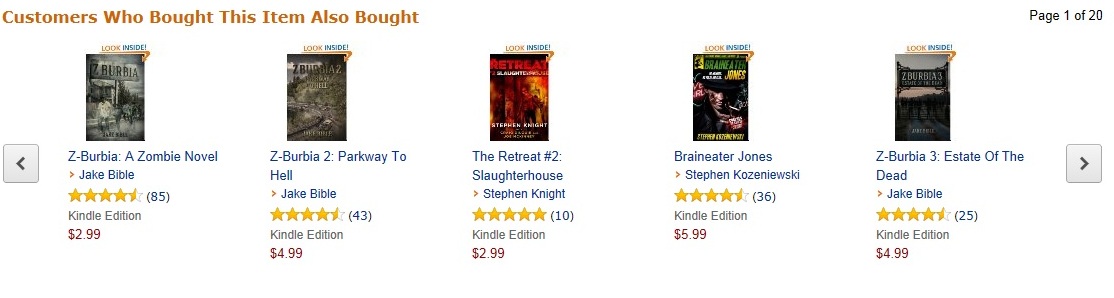
    Also Boughts
    This is a screen capture from the Amazon page for my sophomore novel THE GHOUL ARCHIPELAGO. Basically, it’s as simple as it sounds. People who bought TGA from Amazon also bought the books listed here from Amazon at some point in their lives. You can scroll through twenty screens of Also Boughts (a hundred books) but this one is the one that pops up automatically every time you click on my book’s Amazon page. It represents the five books that customers most commonly also buy along with mine.

    As you can see, one of them is my debut novel, BRAINEATER JONES, which makes sense. My friends, family, and whatever constitutes my burgeoning fanbase have bought both of my books. (Thanks, everybody, by the way.) Another book is by an author I’m not familiar with, Stephen Knight, but I’m going to go out on a limb and guess that since we’re both Stephen Ks and we write horror, there’s been some overlap there.

    All three of my other Also Boughts are from Jake’s Z-BURBIA series. Why is that? Well, for one thing we share a publisher, the great Severed Press out of Hobart, Australia, so there’s probably some common interest there. My novel came out around the same time as Z-BURBIA 2, so we probably shared some buyers due to time as well. But I’m guessing the main reason why Jake takes up the lion’s share of my Also Boughts is that we write similarly appealing novels.

    So what does all this mean? Why does it matter to me as an author or you as a reader? Well, believe it or not, if you’ve ever been on Amazon before you’ve seen this ribbon, or, at least, a similar one. You also as likely as not have clicked on it before. You may not even remember doing so. And that’s the beauty of it.

    Amazon is a business. For authors, in some ways (both disturbing and exciting) it’s THE business. Which makes their business model wholly fascinating and worthy of at least a cursory analysis. You can bet your sweet bippy that if people didn’t click on Also Boughts and buy some at least now and then Amazon wouldn’t waste the money on web designers and bandwidth to have that ribbon on every page they maintain. So why do they do this? Because (repeat it with me now) they’re a business. The Also Boughts lead to more sales.

    Imagine yourself back in the near-mythical olden days of yore known as “The Nineties” when brick-and-mortar stores littered the landscape. I could walk into a bookstore and expect to see shelves of staff picks. Jimmy and Johnny and Joanie who all worked at Books ‘R Us would all set up their personal favorites for us to peruse. And if I knew that I shared taste with Jimmy, I could always pick up one of the books from his shelf and be happy.

    And if I DIDN’T trust ANY of those folks, I could still walk up to whoever was working the counter that day and have a conversation like this:

    “I’m looking for a book but I don’t know what I want.”

    “Well, what do you like to read?”

    “Zombie novels.”

    “More like gory or more like funny?”

    “Gory.”

    “Here, try this, it’s the newest one by Kozeniewski. He does gore well.”

    So fast forward again to 2014. (Thank God that trip down memory lane was truncated. I don’t think I could handle another minute without my iPhone.) Amazon has displaced brick-and-mortar stores but the one thing it CAN’T offer you is a clerk who more or less can tell you what to buy, and increase the store’s overall sales. Hence the Also Boughts.

    Right when you consider whether to purchase a book or not you are presented with a whole slew of similar books to buy. (Or videos or ping pong tables, or whatever.) And even AFTER you purchase it Amazon will continue to tell you things you may be interested in based on your purchasing history.

    Did you ever notice that maybe you bought a My Little Pony once for your niece ten years ago and to this day Amazon recommends pony stuff to you? That’s because the things in your purchase history are considered even more relevant than just the things you’ve perused.

    So, long story short, Jake and I drive traffic to one another’s books. (I’m sure it’s much more one-sided and more likely that I simply benefit from Jake’s popularity.) Every time you look at my book you see his and at least consider clicking on them. This is one of the reasons why it’s beneficial for authors to write more books, so they have more Also Boughts, and potentially more criss-crossing traffic, but that could be the subject of a whole other blogpost.

    So in closing I want to say thanks to Jake for hosting me on his blog and for taking up not just one, not just two, but three of my all-important Also Bought slots. I hope I helped to pull back the curtain a little bit on how Amazon works in this one particular mechanic and why it’s so important to authors and other content producers. Thanks for reading and remember: ZOMBIES FOREVER!
    The_Ghoul_Archipelago_ebook_coverBRAINEATER JONES cover


    ***

    There you have it, folks! (Check is in the mail, Stephen).

    Go get some of his books and then you’ll be able to see that others want my books too! GET THEM ALL! YES, I’M STILL YELLING!

    Cheers!


  • Captains ChairBlog

    Ahoy, Mateys!

    Over the next few weeks I’ll be taking a step back and letting some other writers get into the captain’s chair. Well, not literally because the captain’s chair is MINE ! MINE MINE MINE! But I am going to let them do some guest blogging. It’s always nice to have other opinions.

    This week I give you the one, the only, the The Dunwoody- David Dunwoody!

    Insert Bio and pic

    Enjoy!

    ***

    1798699_10152518004852835_2640805279392116019_nDavid Dunwoody writes subversive horror fiction, including the EMPIRE zombie series and the collections DARK ENTITIES and UNBOUND & OTHER TALES. Most recent is his post-apocalyptic novel THE HARVEST CYCLE. His work has been published by such outfits as Permuted, Chaosium, Shroud, Gallery, Belfire and Dark Regions. More info and free fiction at daviddunwoody.com.

    The Idea: From Inception to Perception
    David Dunwoody

    It usually starts with a “What if?” Often, at least in my experience, it’s “What if this happened instead of that?” Many such notions flit through a writer’s head every day, and a handful of them get snagged in your writerly web and start to become more than just notions.

    Developing an idea into a premise – something to be built upon, a three-dimensional framework supporting characters and feelings and color – is a process which varies widely from person to person. It doesn’t always come naturally with each effort. When I was younger, many of the stories I wrote were what are sometimes called “idea stories.” That is to say, they present the “What if?” and then…that’s kinda it. I didn’t invest much in character development or in describing a rich environment – unless, of course, those things were essential to the “What if?”. For example (and I’m just making this up as I write) say the idea is “What if a human werewolf was exiled to Saturn? What would the multiple moons do to him?” The story that followed would pretty much explore the different possible answers and then it’d be done. The exile would have a thin backstory about how he ate his wife or something. Some cursory reading on Saturn would inform me that it’s considered a gas giant and I’d change the planet to Neptune, and then get lost in details like gravity and atmosphere. Would probably invent some flimsy futuristic technology to explain those problems away. (So now not only is the character suffering, I’m getting lazy because I want to focus on how wild and freaky the werewolf is going to be.) Then I’d need to explain why a werewolf would be shot to freakin’ Neptune instead of simply being shot with a silver bullet. Okay, he’s an unkillable super-werewolf who contracted lycanthropy while on a space mission, so they send him back out there.

    Now, somewhere in this mess there was a character who I haven’t named yet. And I think he ate his wife so he’s sad.

    The character’s experience and emotion is what anchors the story and draws the reader in. It makes the world real and can even make an outlandish starting point (like our Neptunian werewolf) seem real. At the very least, the reader will be willing to suspend disbelief.

    Embarrassing as it is to say, there was a time when I thought the initial idea with all its bells and whistles would suffice. Eventually I began to notice that the fiction I enjoy doesn’t just have neat ideas, it has characters who feel authentic, even if I’ve never met such a person in my life. Especially then.

    Our tragic space oddity – Major Tom will do for now, why not? – has an entire lifetime’s worth of memories and feelings, many of which have nothing to do with how he wound up on Neptune but are just as important. And he didn’t eat his wife. Maybe he had a wife – maybe they were divorced long before he took his first spaceflight, maybe she’s long out of the picture but he still thinks about her. Even now, in the frozen hell of Neptune, his body being torn asunder by the effects of its fourteen satellites, he still thinks about her. He knows she doesn’t think about him but he thinks about her. And while being locked in a monstrous cycle of transformation at the ass-end of the solar system doesn’t bring him and his ex any closer, it turns out she doesn’t feel any more distant than she ever did. So he lets go, he embraces the beast. And then maybe he sees a giant ice worm and jumps on it with a baleful howl. ICE WORMS.

    That’s a start, at least. I want to know why Major Tom became a spaceman in the first place. I want to know how it felt to be condemned by an entire planet. Did it help to have traveled beyond Earth’s orbit, to have seen the pale blue dot from the outside? Or was it worse? Most of all I want to know why she doesn’t think about him, even now. That’s the most intimate question and I think I know the answer, but I’m supposed to be making some sort of point about writing. I guess what I’m trying to illustrate is that, even if you’re an idea writer and still struggling with characters, the fact is that delving into the world inside a character can be just as mysterious and compelling and fun as sending a werewolf to Neptune. Plus, remember that you are also sending a person to Neptune, and it’s on the person’s back that your reader is hitching a ride.

    Many authors say you should write for yourself first, then the audience. I agree with that. I also feel that, if you have come to the outrageous conclusion that people should pay to read your stories (and though we never phrase it in that way, it’s what we believe) then you ought to at least keep the reader in mind. Don’t cater – challenge them as well as yourself – but don’t forget them in the rose-hued puppy love that often accompanies a new idea. And never forget that you are a reader and that you love great characters too.

    ***

    Thanks, David! Great post!

    Be sure to head to The Dunwoody’s website and check out all the awesome fiction he has waiting for you there!

    Cheers!


  • Captains ChairBlog

    Ahoy, Mateys!

    Short post today due to deadlines, deadlines, deadlines!

    Which segues right into my reminder of last week’s post. I’m looking for guest writers! If you have an idea for a blog post on writing then let me know! You can read the original call to words here.

    This week’s post, however, is about something I’m still new to: cons.

    Just for full disclosure, I wanted the title of this post to be COOOOOOOOOOOOOOONNNNNNNNN!!!! You know, like a play on Wrath of Khan? Except I quickly realized it looked I was just yelling coon. Probably not the best way to make friends. Why did I share that? So you don’t make the same mistake one day. I’m just looking out for you. The more you know.

    But, on to the subject!

    Cons. Con is short for convention, if you were not aware. There are a billion of them out there put together on subjects from comic books to steampunk, pop culture to zombie culture. Scifi, horror, romance, adventure, what have you. If there is a fan base then there is a con for it.

    Which is pretty cool.

    I’ve only attended six cons, four of them local. I’m about to be an invited guest this coming weekend at ConCarolinas. Very cool. Especially since the Guest of Honor is none other than George RR Martin.  There are still Friday and Sunday tickets left, so go get some and come see me.

    Why do I do cons? To meet fans, make new fans, make new friends, see old friends, and also to network. As a writer, that is the key right there: networking.

    My first con, Horror Realm in Pittsburgh, is where I met a ton of my fellow horror authors I now call friends. It’s also how I got the idea to write Little Dead Man. Which ended up getting me my first agent and is now a Permuted Platinum title ready to be let loose on the shelves of Barnes & Noble and other bookstores come July 15th!

    Word.

    Without having gone to that con I would never have been directed towards the idea of writing a YA zombie novel. That would have meant I wouldn’t have been signed with Permuted Press and wouldn’t have been contracted to write my Middle Grade scif/horror series, ScareScapes. Or been given the chance to write my new space opera series based on the great English kings Edward I, II, and III (and the Black Prince!). One con got me all of that. After a few years of hard work, of course.

    So what will this next con bring me in terms of my career? I don’t know.

    What I do know is it will bring me expenses: gas, food, hotel, cost of books to sell at my author table (which wasn’t free, although it was very, very reasonable). Sure, I get to write it all off at the end of the year on taxes, but that money still comes out of my pocket up front. I’d probably do a lot more cons if it wasn’t for the cost.

    And that’s the balancing act: what it is worth to my career versus what it does to my bank account.

    I’d say, so far, cons have been way worth it, but I read horror stories out there of authors attending cons and the aisles were dead. Or just filled with costumed attendees that aren’t looking to buy anything and really just want to win the cosplay contest. What will ConCarolinas be like? Will I network or will I flounder and lose my shirt? Again, I don’t know.

    But I’ll make sure and document the experience for you (pics!) and let y’all know how I thought it went. I’ll get to hang with some awesome folks, take part on some cool panels, maybe sells some books and make some new fans. Who knows? Sky’s the limit!

    So be on the lookout for my post-con report! And also be sure to follow me on Facebook and Twitter so you can get the “live” reporting.

    Word.

    Cheers!

    Disclaimer: Views From The Captain’s Chair are just that: views. These are not laws. These are not set in stone. I could be totally wrong. I could be off my rocker (shut up). I could be full of S-H-I-T. I could change my mind next week. All of that is possible. Who knows? But if even just a little of this helps you then I’m happy with that. If it just makes you stop and think then I’ve done my job. Which I really need to get back to. Blogging don’t pay for the bourbon! Oh, and the whole Captain’s Chair thing? Yeah, I write in a captain’s chair. It’s true, Mateys! Got a question? Need some one on one? Shoot me an email, a DM, a PM (no BMs) or comment below.

    Jake Bible lives in Asheville, NC with his wife and two kids.

    Novelist, short story writer, independent screenwriter, podcaster, and inventor of the Drabble Novel, Jake is able to switch between or mash-up genres with ease to create new and exciting storyscapes that have captivated and built an audience of thousands.

    He is the author of the bestselling Z-Burbia series for Severed Press as well as the Apex Trilogy (DEAD MECH, The Americans, Metal and Ash), Bethany and the Zombie Jesus, Stark- An Illustrated Novella, and the forthcoming YA zombie novel Little Dead Man (available July 15th!), and Teen horror novel Intentional Haunting (both by Permuted Press).

  • Captains ChairBlogAhoy, Mateys!

    This week’s post is a bit blue. That means there will be naughty words. You have been warned.

    Fuck.

    Fuckety fuck fuck.

    Fuck fuck fucker fuck.

    Yep. There be fucks in these here waters.

    If you read the reviews of my novels you will quickly notice a pattern. I’m not talking about the obvious adoration of my prose and wit. No, no, I’m talking about those folks that have taken offense to my use of cursing.

    While it is fucking true that I do fucking curse a whole fuckton, it should be said that every complaint against the cursing is flat out misplaced. I’m not saying people don’t have the right to be offended. I would never say that. I’m just saying that maybe, just maybe, if you don’t like the word fuck then perhaps reading post-apocalyptic horror may not be a good idea.

    Because here’s the thing, folks: people curse in this world a lot right now. What the holy fucking hell do you think is going to fucking happen when the dead walk the mother fucking Earth?

    I write post-apoclayptic horror as well as military scifi and military thriller/adventure novels. Horror and the military. There will be fucks. Lots and lots of fucks. The military alone is known for mouths that would burn a saint’s ears. Add in some hellish nightmare situations and what do you get? Yep. Lots and lots of fucks. That’s life. That’s reality. That’s how people talk.

    Yet, I still get complaints. And I don’t understand it.

    Just the other day I was with my family, just driving along down the road like we do. Pretty sure we said fuck at least a dozen times per mile. Not to mention cock, shit, pussy, cunt licker, whore bag, douche nozzle, tits, and asshole. I can guarantee that I am forgetting some choice words.

    And that was just my family. On a normal day. In the car. Is it any wonder my characters are so profane? Write what you know, and all that jazz.

    My novels are filled with dialogue. My characters talk. Rarely is there a scene where the characters aren’t bantering back and forth about something. And if there is banter, then there is cursing. That’s how it works. Despite my name, I don’t write Christian fiction. I am not looking to elevate the art of language. I’m looking to reflect how people speak in real life then turn it up to eleven as the danger, stress, terror, fear, violence, and mayhem gets turned up to eleven as well.

    For the record, I don’t do it lightly. Every fuck is carefully placed. I wrote Dead Mech as a drabble novel. That means every single section had to be exactly 100 words. When I used the word fuck I made damn well sure it fit the scene. The dialogue had to have that perfect cadence or the words would be wasted. And when you only have 100 words per section you sure as shit don’t have room for waste.

    Of course, my YA, Teen, and Middle Grade novels don’t have the f-bomb in them. I kind of wish they did, but that’s the market. I will say that I invented a euphemism for my Middle Grade horror: fruit. It’s the catchall curse word. Noun, verb, adjective, adverb. It does it all. There is a story reason the characters all use that word, but you’ll have to fruiting wait to read the books to find out why.

    I’m not the only author out there known for a potty mouth, but I am one of the few that embraces my language and has zero intention of taking any of the criticism to heart. I will not change how my characters talk. If the character in real life would say fuck every third word then the fucking character in the fucking book sure as fuck is going to fucking say fuck every third fucking word. To do it differently would be dishonest.

    And I may be a foul mouthed wordsmith, but I’m an honest one.

    Not going to beat a fucking dead horse over this, just wanted all you fucking wonderful people out there to know that excessive cursing is not the problem, it’s the use of the word “excessive” that’s the problem.

    Because, and say it with me, you can never have enough fucks!

    Cheers!

    Disclaimer: Views From The Captain’s Chair are just that: views. These are not laws. These are not set in stone. I could be totally wrong. I could be off my rocker (shut up). I could be full of S-H-I-T. I could change my mind next week. All of that is possible. Who knows? But if even just a little of this helps you then I’m happy with that. If it just makes you stop and think then I’ve done my job. Which I really need to get back to. Blogging don’t pay for the bourbon! Oh, and the whole Captain’s Chair thing? Yeah, I write in a captain’s chair. It’s true, Mateys! Got a question? Need some one on one? Shoot me an email, a DM, a PM (no BMs) or comment below.

    Jake Bible lives in Asheville, NC with his wife and two kids.

    Novelist, short story writer, independent screenwriter, podcaster, and inventor of the Drabble Novel, Jake is able to switch between or mash-up genres with ease to create new and exciting storyscapes that have captivated and built an audience of thousands.

    He is the author of the bestselling Z-Burbia series for Severed Press as well as the Apex Trilogy (DEAD MECH, The Americans, Metal and Ash), Bethany and the Zombie Jesus, Stark- An Illustrated Novella, and the forthcoming YA zombie novel Little Dead Man, and Teen horror novel Intentional Haunting (both by Permuted Press).

  •  

    Captains ChairBlogAhoy, Mateys!

    So, a Facebook friend of mine, who is a game designer, posted about how he wondered if game developers wished they hadn’t created the $.99 app monster years ago. He talked about how someone puts in hours and hours of hard work, but can’t get into the market unless they sell their work/art on the cheap.

    I quickly commented it was the same for novels too.

    Someone else quickly commented on how the $.99 model works because of volume.

    It’s time to destroy the “volume” myth and all the other stupid selling myths and shoot those pieces of crap arguments out into space.

    Discounting is a marketing tool, not a business model.

    Say that with me, “Discounting is a marketing tool, not a business model.”

    I want that to run through your head every time you think you have an argument against what I’m about to write, okay? Okay.

    Oh, and I have another saying, “Live by the discount, die by the discount.”

    Before I became a writer I was in sales and marketing. I spent nearly a decade dealing with margins and markups, discount percentages and BOGOs, promotions and tricks of the trade. I learned a lot about commerce in that time.

    What I also learned is that if your business model is based on slim margin pricing and discount wars with your competition then eventually you will lose and go out of business. I watched store after store after store in the Southeast, especially South Florida, decide to play the discount war game. None of those stores exist anymore.

    Who does exist? The large retailers. The ones with deep pockets that could wait out the discount wars and keep prices where they wanted. They survived.

    It’s the same with pricing novels. The $.99 business model for self-published novels is killing the business for everyone. Knock it off. Just stop doing it.

    Why? Because if everyone is pricing their novels at $.99 then the consumer no longer sees $.99 as something special. No one is gaining volume sales from that price point because the market itself is glutted with a volume of cheap novels.

    One of my publishers, Severed Press, only uses the $.99 price as a promotional tool and only for a couple of days each quarter. My novels are regularly priced at $2.99 for the first in a series and $4.99 for the rest. I am consistently on bestseller lists.

    And the only time one of my novels was offered for free was to launch the reboot of Dead Mech which had been in the market as a self-published title for a few years. It gained some new readers, but now stays at $2.99 with the sequels at $4.99.

    This works. And you know what? It’s the same business model that has been used for mass market paperbacks for decades.

    Oh, I can hear you sputtering objections left and right. Knock it off. When you offer your work for cheap then you cheapen your work. Why does my stuff sell at $2.99 and $4.99? Because it appears to be higher quality by being offered at a higher price. My work isn’t in the discount bin.

    “But volume! Volume! VOLUME!”. Shut the fuck up. Volume is a lie.

    When I was a sales manager, my boss had a saying, “Would you rather have slow dimes or fast nickels?” The entire industry loved that saying and bought into it.

    Yet, there was one major flaw. It only offered two choices. You could pick “slow dimes” or “fast nickels”.

    What about fast dimes? Or, better yet, fast dollars?

    In the post about apps being $.99, the commenter went on to say that you make up in volume what you lose in price. That’s crap. Why? Because that’s assuming the product sells at volume!

    Wal-Mart is the world’s largest retailer and sells more volume than any other entity on the planet. Do you think every single product that gets put on the shelf and discounted sells a ton of volume? No. Not even close. That’s why Wal-Mart is constantly shifting its inventory and clearing out the slow movers.

    Guess what? Your novel, despite being priced at $.99, could easily be a slow mover. And you will have lost money as you played the discount game.

    Still not convinced? Well, maybe the leader in ebooks will convince you. Amazon gives only 35% of royalties to authors if their books are priced below $2.99 or over $9.99. Priced at $2.99 to $9.99? 70% royalties. Amazon knows that selling books below $2.99 cheapens the product and they discourage it.

    But folks ignore the people that pretty much invented the ebook marketplace and still play the discount game.

    It makes no sense. None at all.

    Oh, I hear another argument coming. It’s the “But so many authors have had huge successes selling at $.99!”

    Not true.

    “But look at blah blah blah and blah blah!”

    Really? Count on your hands how many writers you know of that have made their fortunes selling novels for $.99. Come on, do it. Do it. Dooooooo iiiiiit. How many did you count? Three? Five? Ten? Out of how many total writers sell their books for $.99? Do the math, please, before you try to convince anyone, especially yourself, that the $.99 model works.

    The ones that have made it work? They are an exception to the rule. The majority of $.99 books do not sell. Just like the majority of books don’t sell. Please never use outliers as an argument for success. They are an ideal, not an example.

    The plain truth is no one in the publishing industry knows why one book sells and another doesn’t. So why limit your income chances by going cheap? It just doesn’t make sense.

    Now, do I expect this post to change anyone’s mind? Probably not. There is a cult of publishing out there that refuses to listen to reason or look at history. Why? Your guess is as good as mine.

    But, maybe, just maybe, we can get some authors that have some common sense to just stop the madness and price their novels in the non-cheap range. Low cost is good ($2.99-$4.99), but discounted at $.99 forever is not.

    One last thing, that “free” model? It’s a lie. You see a bump, gain maybe half a percent more readers, but in the end the majority of your “sales” are to people that troll the free lists and never buy a damn thing. Why would they? They can read free crap the rest of their lives.

    Please take a hard look at how and why you price your novels the way you do. This is a business and the entire health of a business is based on revenue. You want that health to start strong, not weak, right?

    I know I do.


    Cheers!

    Disclaimer: Views From The Captain’s Chair are just that: views. These are not laws. These are not set in stone. I could be totally wrong. I could be off my rocker (shut up). I could be full of S-H-I-T. I could change my mind next week. All of that is possible. Who knows? But if even just a little of this helps you then I’m happy with that. If it just makes you stop and think then I’ve done my job. Which I really need to get back to. Blogging don’t pay for the bourbon! Oh, and the whole Captain’s Chair thing? Yeah, I write in a captain’s chair. It’s true, Mateys! Got a question? Need some one on one? Shoot me an email, a DM, a PM (no BMs) or comment below.

    Jake Bible lives in Asheville, NC with his wife and two kids.

    Novelist, short story writer, independent screenwriter, podcaster, and inventor of the Drabble Novel, Jake is able to switch between or mash-up genres with ease to create new and exciting storyscapes that have captivated and built an audience of thousands.

    He is the author of the bestselling Z-Burbia series for Severed Press as well as the Apex Trilogy (DEAD MECH, The Americans, Metal and Ash), Bethany and the Zombie Jesus, Stark- An Illustrated Novella, and the forthcoming YA zombie novel Little Dead Man, and Teen horror novel Intentional Haunting (both by Permuted Press).